

The Danish Maritime Authority would like to be more proactive early in the development processes for new fuels, ensuring safe solutions as well as even better rules for seafarers in the long term.
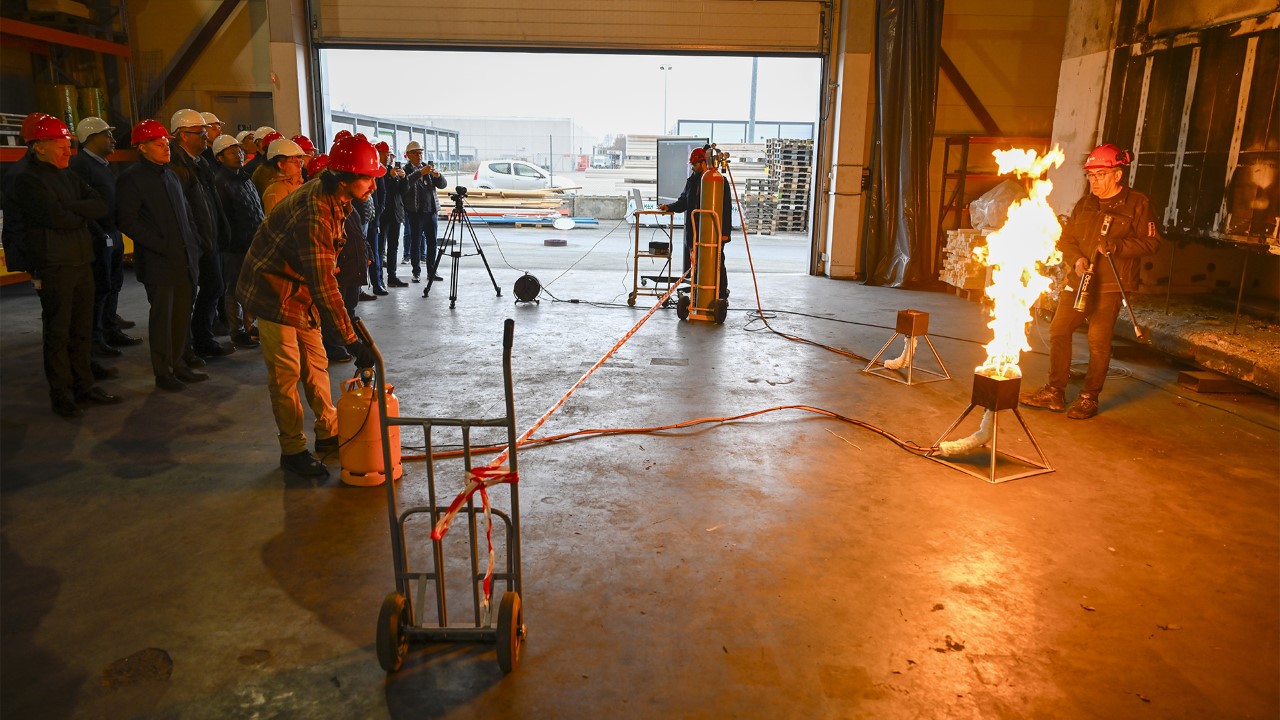
In December 2025, the Danish Shipowners’ Accident Insurance Association was present alongside a number of the company's members when DBI – Danish Institute of Fire and Security Technology held a workshop in continuation of the Metafuel project, which deals with the safety challenges related to the use of methanol, ammonia and hydrogen as maritime fuels.
In addition to a number of shipping companies and other stakeholders, the Danish Maritime Authority also participated in the well-attended event, represented by, among others, Lasse Grøn Christensen, who is head of the agency's so-called Regulatory Future Lab, which, among other things, handles the approval of ships using new green fuels and alternative technologies.
As a supervisory authority, the Danish Maritime Authority would like to be active early in the development processes around the new fuels – ammonia, methanol and hydrogen – in order to clarify the approval requirements, which are becoming more and more relevant in the Danish shipping sector.
»We have a number of first movers in Denmark who are investing in the new green fuels, and we want to help them on their way to finding good, safe solutions that can achieve approval. And it's super exciting because these are technology areas that we in many cases haven't dealt with before, and where we can't just open the drawer and find a solution,« Lasse Grøn Christensen says.
Different risks than before
In his position, Lasse Grøn Christensen works with several of the Danish Maritime Authority's other departments, including the Supervision Department, where Chief Ship Inspector Torsten Arnt Olsen is part of the management team. This is where the specific approvals are issued on the basis of rules that have been developed on the basis of the technologies that have been known for the past more than 50 years.
»But when we start using ammonia instead of diesel on the engines, we have to deal with some other fuel characteristics, and therefore also some different risks than before. For better or worse, the rules are in many ways shaped by accidents, and we don't have them in this case, so we have to take it step by step,« he says.
The Danish Maritime Authority's Office for Climate, Environment and Green Transition is also involved in the effort, and for Senior Consultant Mette Festersen Jensen, who works with regulatory development under the auspices of the IMO, the safety aspect is crucial in relation to the introduction of alternative fuels.
»We have an ongoing dialogue with DBI, among others, about their focus on fire safety, but also in general when we talk about safety with the alternative fuels, and the new risks we must be able to handle in the future, and what this means for the development of the rules,« she says.
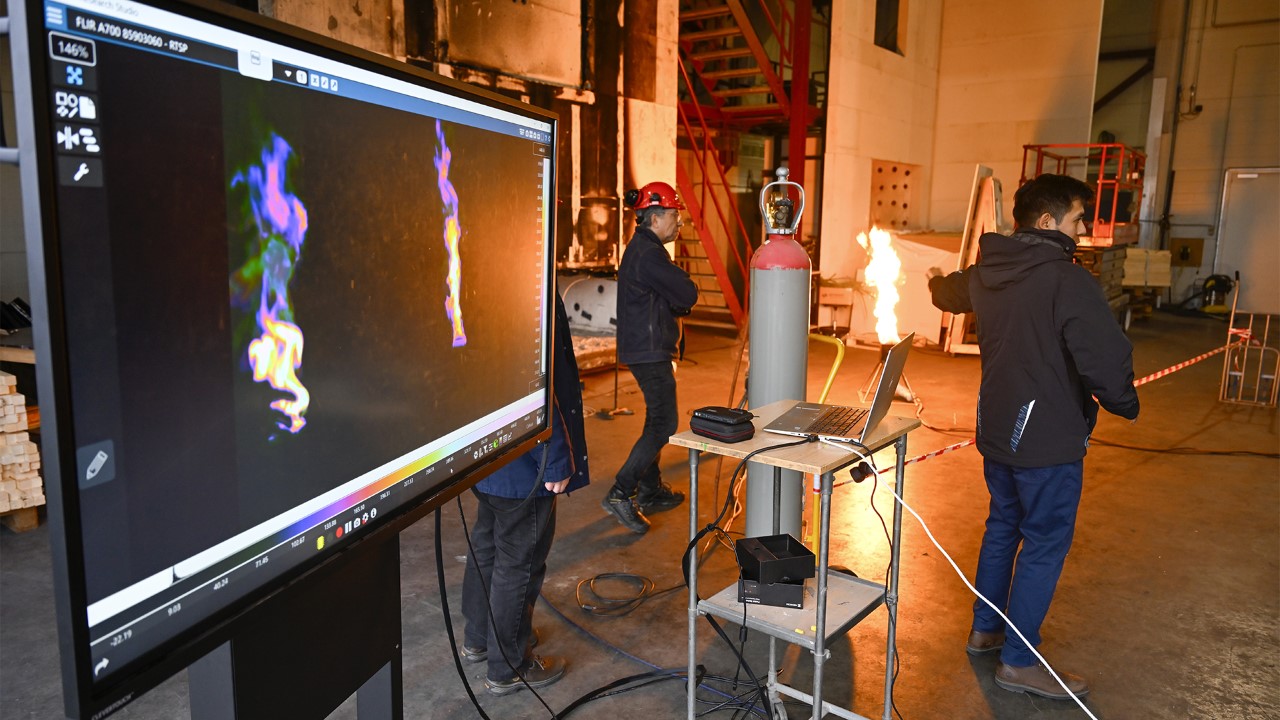 Via infrared cameras, among other things, the participants at the event could gain insight into the effect of, for example, burning methanol./div>
Proactiveness and precautions
In order for the Danish Maritime Authority to be able to approve something, the people involved first need to understand what it is they need to approve, Torsten Arnt Olsen points out. Until the risks posed by the use of the new fuels are known, an approval of the measures being taken to meet them is impossible.
»We need to acquire some knowledge about these new fuels and new ways of doing things. We need to share knowledge and exchange experiences with different organizations and stakeholders who work in this area, because I don't think anyone knows everything,« he says.
In the classic role of authority, the Danish Maritime Authority is not normally very active as a partner in the early stages of a development process regarding safety measures and approval procedures, but that is very much the ambition in this case, Lasse Grøn Christensen emphasizes.
It is not least the toxicity of ammonia that seafarers must be aware of, Torsten Arnt Olsen says. This applies to everything from bunkering to use on board, where the fuel circulates from the tanks to the engines, which Everllence is also currently testing.
»Despite countless measures aiming at 100 percent safety, in principle leaks can still occur around the system. So, there are many areas where you have to be proactive and take precautions – as best you possibly can,« he says.
And the introduction of the new fuels affects the entire value chain, Mette Festersen Jensen adds, which is why there is a need for knowledge sharing all the way across from authorities and classification societies to shipping companies and equipment manufacturers.
Important to establish new experience
One of the sets of rules that the Danish Maritime Authority operates according to on regarding safety is the SOLAS Convention, with a history going all the way back to 1914, when the first version was adopted in response to the sinking of the Titanic two years earlier. The latest version was adopted in 1974 but has been updated diligently ever since.
»Over the years, it has become a fairly comprehensive regulatory framework well suited to handle the risks presented by ordinary internal combustion engines running on diesel and other known fuels on board a ship. When we switch to ammonia, it has a different flammability. Maybe not actually worse, but different, and then you have to do some slightly different things,« says Torsten Arnt Olsen.
Ammonia can be a major risk for seafarers if the right precautions are not taken, he further emphasizes. But with the proper foundation in place, it will be possible to handle the fuel in a responsible way, he believes.
»We have many, many decades of worth of experience with diesel, which we don’t have with ammonia as a fuel – yet. Therefore, it is important to collect the knowledge that is created here in the test phase and through simulations, and not least when it starts coming into service,« adds Lasse Grøn Christensen.
Methanol is already in operation, which UFDS has previously visited Laura Maersk to talk to the crew about. And as Chief Engineer Heino Søgaard Nielsen said on that occasion, he was 'not worried about sailing with methanol at all.'
Similarly, Torsten Arnt Olsen also wants to 'de-dramatize' the talk about alternative fuels a bit by stressing that these are not necessarily more dangerous than the usual fuels, even if they are accompanied by a different set of risks for handlers to deal with.
»We have what we call interim guidelines, i.e. some guidelines that will eventually become applicable rules in the IMO. To this end, we have an important task of getting some experience back to the IMO, so that the industry can get some rules that work in the long term,« Mette Festersen Jensen says.